| The
process starts with an automated feed table on which the loader
operator places the incoming big bales. The machine accepts
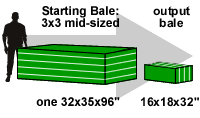
both 32”x35” and 46”x35” big bales
(or 46"x51" big bales with the 4x4 option). This
table then advances the big bales into the cutter box which
tilts them on their edge to allow for the proper cut. Once
the bale has been sliced into sections of 16” x 35”
(or 48" on 4x4 option), the bottom slab is slid over,
allowing the next slab to fall down behind. These slabs are
then pushed forward into the weigh chamber while the operator
removes the old twines. Here the simple adjustable beam scale
determines the proper amount of hay, which is sectioned off
by the feed forks. At this time, the weighed slab is split
and advanced onto the lift table. The lift table then raises
the slab into the actual compression chamber. The main compression
ram now applies pressure against the slab reducing its length
approximately 15% depending on the selection made for the
finished bale length. Once compressed, the eject cylinder
forces the bale horizontally into the banding chamber. The
bale is held with two steel plates, while the banding unit
places bands transversely along its width. The number of bands
is selectable, but normally would be four or six. Once this
process is complete, the next bale extrudes the finished banded
bale out and it expands to its finished length, depending
on the selection, then is fed into the secondary cutting box.
This cutter slices the bales from one 16” x 36”
into two 16” x 18” bales (or into three 16x19s
with the 4x4 option). After slicing, the bales are fed into
the accumulation stacking table which groups them into proper
configurations for mechanically handling into storage or onto
a trailer. The entire process happens in approximately 30
seconds with the standard machine, or 15 seconds with the
higher power option. The power for this operation comes from
an electric driven hydraulic power station consisting of multiple
30 hp motors, each driving hydraulic pumps. The automation
is controlled by a PLC (programmable logic controller), with
full operator manual overrides. All manual functions are protected
by the PLC to prevent operator damage. All necessary guarding
is supplied and safety shutdowns and lockout systems are integrated
via the PLC.
|